


Chicago Immigration Attorney

Мы говорим по русски
USCIS Signals Major Shift in Adjustment of Status Adjudications
USCIS Signals Major Shift in Adjustment of Status Adjudications
By Julia Sverdloff, Immigration Attorney and Founder of Sverdloff Law Group
Last Updated: May 2026
For decades, Adjustment of Status has served as one of the most important legal mechanisms in United States immigration law. It allows eligible individuals already present inside the United States to apply for lawful permanent residence without departing the country for immigrant visa processing abroad.
Historically, most Adjustment of Status adjudications focused primarily on statutory eligibility. If an applicant properly qualified under the Immigration and Nationality Act, submitted sufficient supporting documentation, established admissibility, and passed required background checks, the case generally moved toward approval absent significant concerns.
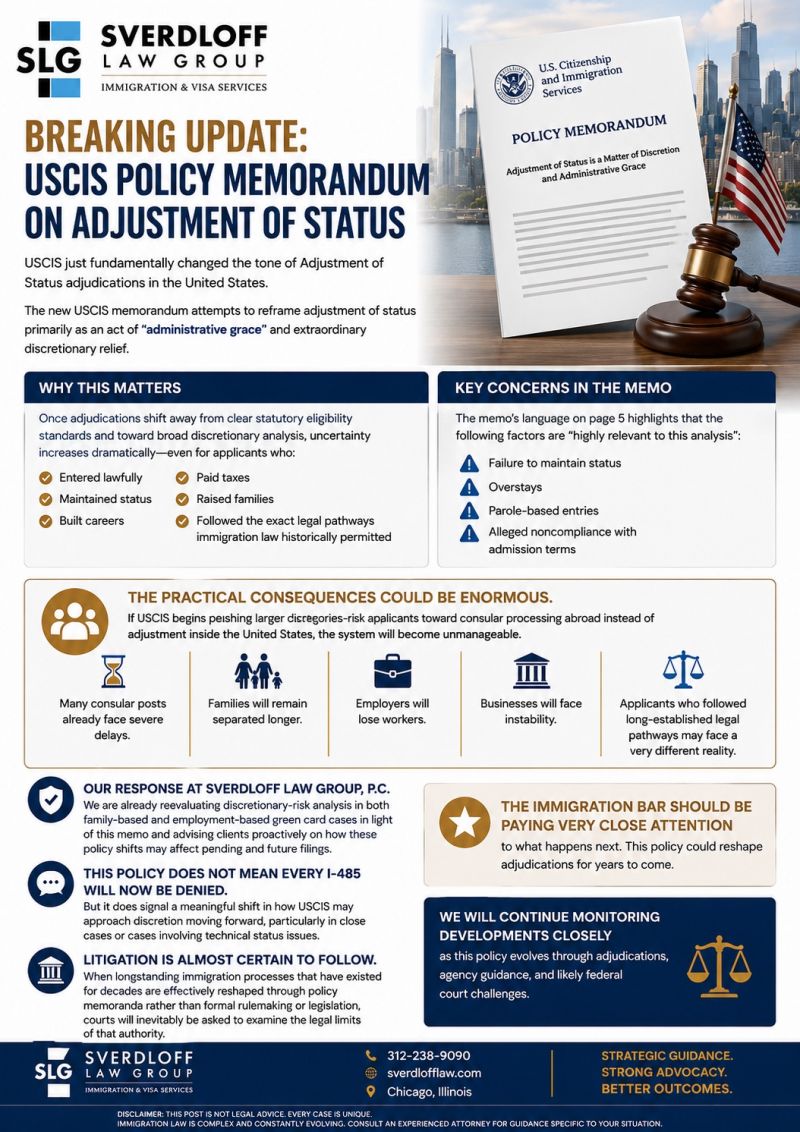
A newly issued USCIS policy memorandum may signal a meaningful shift in how the agency approaches green card adjudications moving forward.
USCIS is now placing substantially greater emphasis on the discretionary nature of Adjustment of Status adjudications, repeatedly describing permanent residence through adjustment as an “extraordinary” benefit and an exercise of administrative discretion rather than simply a procedural immigration pathway. While discretion has always existed under INA § 245, the tone and framing of this guidance suggest that officers may now be encouraged to apply heightened scrutiny even where applicants otherwise appear statutorily eligible.
That distinction matters.
Once immigration adjudications move away from relatively predictable statutory analysis and toward broader discretionary review, uncertainty increases significantly — even for applicants who entered lawfully, maintained status, built careers and businesses, paid taxes, raised families in the United States, and otherwise attempted to fully comply with immigration laws.
In practical terms, applicants should expect USCIS officers to conduct deeper review into overall equities, credibility, prior filings, immigration history, and discretionary considerations that historically may not have carried the same level of importance during Adjustment adjudications.
This policy shift could impact a broad range of applicants, including marriage-based green card cases, employment-based I-485 filings, applicants with prior overstays, individuals with dismissed criminal matters, waiver applicants, asylum applicants adjusting status, and cases involving complex immigration or procedural histories.
Importantly, approval of an underlying petition such as an I-130 or I-140 does not guarantee approval of the Adjustment of Status application itself. USCIS officers retain broad discretionary authority over the final green card adjudication process, and this new memorandum appears designed to reinforce more active use of that discretion.
As a result, many applicants may begin seeing increased Requests for Evidence, more intensive Adjustment interviews, broader review of prior immigration filings, deeper scrutiny into prior representations made to immigration authorities, and longer adjudication delays tied to expanded security vetting and discretionary analysis.
We are already seeing USCIS increasingly issue broader Requests for Evidence and subjectively scrutinize discretionary factors that historically carried less weight in many Adjustment of Status cases. In practice, immigration officers now appear more willing to closely examine prior travel history, social media activity, employment records, prior marriages, dismissed criminal matters, financial history, prior visa applications, and inconsistencies across previous filings.
“The concern is not that USCIS may exercise discretion. The concern is whether discretionary analysis becomes so expansive and subjective that otherwise eligible applicants face inconsistent outcomes untethered from the statute Congress enacted.”
From a practitioner perspective, one of the biggest concerns is that increasingly broad discretionary standards may create substantial unpredictability between adjudications. Two applicants with nearly identical facts may now receive dramatically different outcomes depending on how aggressively discretion is applied during a particular case review.
For many immigration practitioners, the concern is not merely that USCIS officers may exercise discretion. Discretion has always existed in Adjustment adjudications. The concern is whether discretionary analysis becomes so expansive and subjective that otherwise eligible applicants face inconsistent outcomes untethered from the statutory framework Congress actually enacted under INA § 245.
Congress specifically created Adjustment of Status to allow eligible individuals already present inside the United States to obtain lawful permanent residence domestically rather than requiring immigrant visa processing abroad. Many practitioners are now closely watching whether evolving USCIS adjudication standards attempt to narrow Adjustment eligibility beyond what Congress intended when creating the statute itself.
What This Means for Green Card Applicants
Applicants should expect USCIS officers to more heavily scrutinize prior immigration filings, inconsistencies, discretionary factors, prior visa applications, criminal history, and overall credibility. Cases that may previously have been approvable with standard evidentiary submissions may now require significantly more strategic legal preparation.
A properly prepared Adjustment of Status filing today should not merely satisfy minimum filing requirements. Strong cases increasingly require strategic presentation, proactive explanation of potential concerns, organized supporting documentation, careful review of prior filings and government records, and persuasive demonstration of positive discretionary equities from the outset.
This is especially true in cases involving prior overstays, status violations, dismissed arrests, prior visa denials, allegations of fraud or misrepresentation, inconsistent immigration filings, or complicated procedural histories.
The reality is that immigration adjudications are becoming increasingly discretionary, increasingly document-intensive, and increasingly dependent on how well a case is prepared before it ever reaches a USCIS officer’s desk.
Our firm represents Adjustment of Status applicants nationwide, including clients in Chicago, Illinois and throughout the United States facing complex USCIS discretionary issues, Requests for Evidence, marriage-based green card interviews, employment-based immigration matters, and high-stakes immigration litigation.
At Sverdloff Law Group, we continue monitoring evolving USCIS policy developments and representing clients nationwide in complex Adjustment of Status, marriage-based green card, employment-based immigration, waivers, asylum, and removal defense matters.
As USCIS continues increasing discretionary scrutiny in green card adjudications, applicants should ensure their cases are strategically prepared from the outset. Even relatively small inconsistencies or unresolved issues can create significant complications during the Adjustment process. Experienced legal analysis and proactive case preparation are becoming increasingly important in today’s immigration environment.
If you are preparing to file an Adjustment of Status application, responding to a Request for Evidence or Notice of Intent to Deny, or concerned about how evolving USCIS discretionary standards may affect your case, experienced legal guidance is more important now than ever before. At Sverdloff Law Group, we represent clients nationwide in complex marriage-based, employment-based, asylum-related, and high-discretion immigration matters before USCIS and Immigration Court. Our office proactively prepares cases with the level of strategic analysis, documentation, and advocacy increasingly required in today’s immigration environment. To discuss your case and protect your immigration future, contact our office today to schedule a consultation with an experienced immigration attorney.
Frequently Asked Questions
Can USCIS deny Adjustment of Status even if I technically qualify?
Yes. Adjustment of Status is discretionary under INA § 245, meaning USCIS officers may deny applications even where statutory eligibility exists if the agency determines the applicant does not warrant favorable discretion.
Will this new USCIS policy affect marriage-based green card cases?
Potentially yes. Marriage-based Adjustment of Status cases may now receive broader discretionary review involving credibility, prior immigration history, financial documentation, prior relationships, and overall equities.
Can prior overstays or immigration violations affect Adjustment of Status discretion?
In some cases, yes. USCIS may evaluate prior immigration violations, unlawful presence, prior removals, or inconsistencies as part of discretionary review even where waivers or statutory eligibility otherwise exist.
Will USCIS issue more Requests for Evidence under this policy?
Many immigration practitioners expect increased Requests for Evidence, more detailed interviews, and broader scrutiny into applicants’ backgrounds and prior immigration filings moving forward.
What should applicants do before filing an I-485 application now?
Applicants should ensure that all prior immigration filings are reviewed carefully, supporting evidence is organized thoroughly, inconsistencies are addressed proactively, and the case is strategically prepared before submission to USCIS.

Julia Sverdloff, Esq.
Attorney Julia Sverdloff is the founder and owner of Sverdloff Law Group in Chicago, Illinois. Our firm speaks Ukranian, Russian, Serbian, Croatian, Bosnian and Spanish.

CALL US TODAY
312-238-9090CHICAGO OFFICE
NORTHBROOK OFFICE
707 Skokie Blvd, Suite 6
Northbrook, IL 60062
(By Appointment Only)


Attorney Advertising. This information is designed for general information only. The information presented should not be construed to be formal legal advice nor the formation of a lawyer/client relationship. Past results and testimonials are not a guarantee, warranty, or prediction of the outcome of your case, and should not be construed as such. Past results cannot guarantee future performance. Any result in a single case is not meant to create an expectation of similar results in future matters because each case involves many different factors, therefore, results will differ on a case-by-case basis. By providing contact information, users acknowledge and give explicit consent to be contacted via the methods of communication provided, including SMS. Message and data rates may apply. Message frequency may vary. Reply STOP to opt out.
Copyright 2026 All Rights Reserved
Privacy Policy | Accessibility Notice | NUVEW